A report on arsenic and other heavy metal contamination in rice came out the week of 12 2025.
It is indeed correct that rice and other plants are capable of uptaking heavy metals, which are certain metallic elements in the middle of the periodic table that are particularly heavy and dense. While much of it is the fault of industrial pollution, arsenic isn’t entirely the fault of industry because it naturally lives in some soils because of geology.
Unfortunately every country on the planet with a track record of growing rice has some proportion of its rice paddies carrying natural arsenic contamination.
Rice is unique in picking up arsenic because the plants require a flooded field, which temporarily alters soil chemistry enough for the arsenic to be taken up by the plant. The vast majority of other plants that make grains (like quinoa) require unflooded fields, thus reducing arsenic uptake.
An organization called Healthy Babies Bright Futures was responsible for coordinating the rice testing report that came out last week. They paid Brooks Applied Labs to do it, which is an organization in Seattle that specializes in the type of analytical chemistry techniques necessary to measure trace heavy metals. The most important set of results is posted below. The technique they used is pretty sensitive so their total numbers can be a bit higher than some older reports. Their most important experimental result is shown below:
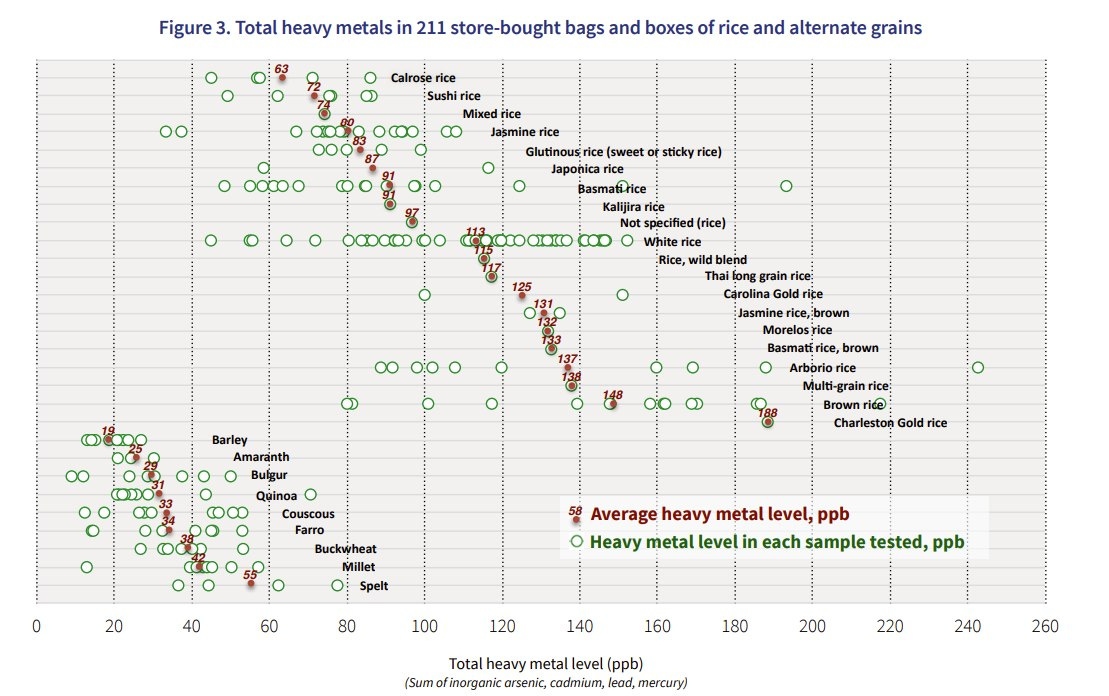
In a sort of unfortunate trade off, brown rice is metabolically healthier, but concentrates more arsenic (in its hull or outer shell). White rice carries less arsenic but is unhealthy for people looking to cut down on carbs.
Soaking the rice before cooking, as well as mixing the grains up, decreases your arsenic exposure. The tradeoff of discarding the water used to cook the white rice is a loss of additional nutrients.
You will not get a loss in IQ points just because you ate rice: while no known level is “safe”, the dose makes the poison. People who work with heavy metals on an industrial basis need to care about heavy metal toxicity the most and follow workplace safety guidelines.
It is indeed reasonable to call on your elected officials to regulate the amount of arsenic in rice or support scientists who want to grow new kinds of rice that don’t take up arsenic as much. It’s not necessary to feed foodphobia from this report.
Some public health measures to decrease heavy metal exposure are way more important like lead paint mitigation, decreasing child exposure to tobacco smoke, and fixing food deserts (not the cherry pies, the lack of availability of healthy food in towns that are less financially well off).
The simplest action plan is to mix up the grains you eat (and same goes for the babies). For example: there is no need to give babies specifically rice cereal as their first solid food: they can get cereal from other kinds of grains. The interested user can also read the report from HBF above and select a grain with less contamination.
 Frank Han's Cardiology Corner
Leave a comment