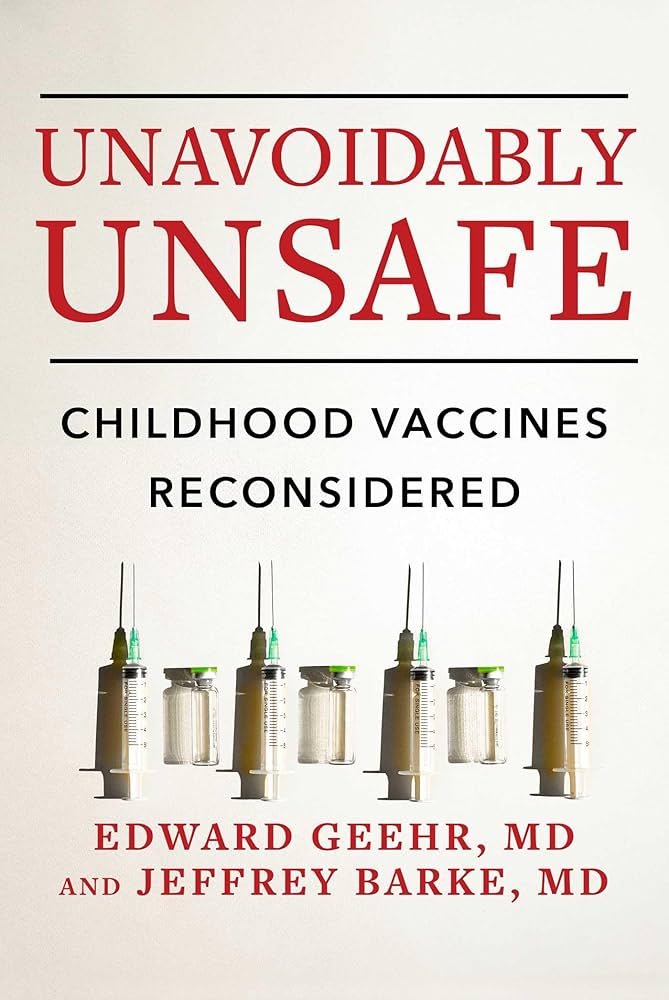
Unavoidably Unsafe is one of ICAN’s latest 2024 books on “vaccine safety”. I place this in quotes because just like everything else coming out of the Informed Consent Action Network (ICAN), their true motivation is to sell antivax fear and misrepresent the facts/ misquote them entirely. This organization does not actually truly care about vaccine safety (otherwise they would have contributed peer reviewed research into the topic). Having followed the antivax ecosystem for some time, I remind the reader that ICAN is a network led by Del Bigtree, whose sole mission is to spread antivax disinformation and profit from doing so. As was previously true in my previous blog posts and is still true in this blog post, someone sincerely antivax saying anything positive about vaccines would affect their bottom line, and so they can only criticize vaccines and recycle their talking points. In this blog post you will see some familiar explainers showing exactly how the authors, Barke and Geehr, got it all wrong or willfully misrepresented vaccine science to try and sell their distorted version of infectious disease/ vaccine science. Barke and Geehr, like all the others who think like them, still don’t get it. This will be split into four blog posts following the four major sections of the book.
Chapter 1 – The Concept of Unavoidably Unsafe
This chapter focuses on the DTP vaccine and the legal case of Bruesewitz v Wyeth. The most important fact omitted from this chapter is that the DTP vaccine has been retired for multiple decades, so the modern reader no longer has to worry about its side effects (it has been replaced by the DTaP vaccine). The conventional medical community did exactly what the antivax ecosystem wanted, which is to remove a vaccine with too many side effects, and replace it with a safer vaccine! This is not spelled out anywhere in the chapter. At least a word of thanks would have been nice 😉 The legal case mentioned stems from a family who believes seizures were related to the DTP vaccine, and so they sued the company that made the DTP vaccine at the time, Wyeth. The actual outcome of the legal case is: “that vaccine manufacturers are not liable for vaccine-induced injury or death if they are accompanied by proper directions and warnings.” In actuality, one of the biggest friends of the antivax movement, Robert F Kennedy Jr, has attempted to sue vaccine companies many times. He should theoretically be the most useful example for ICAN to illustrate that vaccine companies can be sued at anytime, although the most likely avenue of success is under the National Vaccine Injury Compensation Act.
The Cutter incident is mentioned in this chapter, but here’s the actual story: The story of the polio vaccine actually begins with the efforts to make an inactivated and attenuated version of the poliovirus (the Salk and Sabin vaccines). Ultimately, several companies rose to the challenge of mass producing the immunization, and initial studies indicated that this was a very safe and very effective vaccine. Crowds were coming out and lining up to receive the product, since just in the US alone, nearly every family knew someone who was paralyzed by polio. The problem came when a specific company did not inactivate their inactivated virus vaccine well enough, and mistakenly delivered live virus to some children. This caused paralysis in a subset of those children and became a significant incident known as the “Cutter incident”. Just like in all the other cases, epidemiologic studies and mechanistic studies worked together to solve the problem and in the United States, only the inactivated vaccine is currently used. Many rules and regulations have been created since then to avoid another Cutter Incident (even conventional physicians can express sincere frustration that this happened).
Finally, the title of the book fundamentally misrepresents this case (Bruesewitz v Wyeth) – describing vaccines as unavoidably unsafe was never actually written by the US Supreme Court. To go further, vaccines themselves are not “permanently unsafe” which, is what is insinuated by the book authors – rather they have some risks that are outweighed by the benefits. Specifically, like every other medicine, they have side effects. Other courts have discussed the concept at length here. To use some real-life analogies – when you buy a kitchen knife, you implicitly accept the risk of being accidentally cut by that knife, but this a rare possibility. When you drive on the roads, you implicitly accept that there is a permanent risk of car accidents (although in most locations in the world the risk is small). Both of these risks cannot be removed from the product.
Chapter 2 – Do No Harm
The first part of the chapter distorts the medical tenet – “first do no harm”. The issue here is that no level of side effects of vaccines are acceptable to antivaxxers; they live in the Nirvana fallacy. Next, they cite the World Council For Health, which is not a legitimate public health organization, rather it is a gathering of antivaxxers who only have negative things to say about public health/ vaccines. The vaccine schedule in all countries that make them are the result of extensive research and collaboration between epidemiologists, industry, infectious disease professionals, and the biochemists who actually put the vaccine components together. The interested reader only has to browse the decades of CDC ACIP documents to see how much work is placed into deciding what goes on the vaccine schedule. Other countries like Australia, have their own version of the CDC called the Therapeutic Goods Administration, which does similar work (this organization is more analogous to the US FDA). Contrary to the author’s assertions, there is plenty of thinking going into the vaccine schedule.
Next up, the authors complain about the CDC changing the definition of vaccine – no, vaccines still do what they used to do, which is show something to the immune system to get an immune response, as practice for a real infection. In the same section of this book they complain that kids were only tested for antibody responses – it doesn’t require a particularly well-read person to realize that clinical outcomes (hospitalization/ severe disease) were also tested multiple times. The actual practical reason for the wording change is the ability to encompass more categories of vaccines. The book authors are so terrible at reading that they can’t complete basic fact finding.
Next, the authors complain about SV40 in COVID vaccines – first off, this has been disclosed for a very long time contrary to their assertions. To understand what this is about requires a bit of biochemistry. SV40 is the name of a real virus, that mostly causes trouble in certain animals and has weaker evidence for human cancer. Antivaxxers always like to jump in when there is weak evidence for something, but I’m not done yet. The entire virus has never been a part of COVID vaccines ever – just its promoter. A “promoter” is a section of genetic programming code that says to the organism, “copy this a lot”. It’s something like a photocopier being asked to make lots of copies of something. It is physically impossible for the promoter by itself to conjure up the virus, because no complete viral genetic material is there in the first place. A real life analogy – a complete BMW cannot be conjured from thin air and one of its passenger seats. Since the life goal of a virus is to copy itself, at the expense of the cell, most viruses use some form of promoter to accomplish this. The thing is, molecular biologists can take just the promoter, and use it to accomplish other biological experiments useful to humans, like making COVID vaccines. Since the COVID vaccines are manufactured off a template, the promoter, and JUST the promoter, is used in this context to make COVID mRNA vaccine copies. Later on, when copying is complete, the DNA template the promoter lives on is extensively degraded prior to packaging the final vaccine.
Next, the authors complain about aluminium safety – and their claims are extensively debunked by an actual blood brain barrier scientist here.
Next up, the authors complain about vaccines causing autism – to be clear, vaccines have never caused autism, and never will. The strongest experimental evidence for this is the ability of fetal brain scans to detect the brain changes consistent with autism prior to birth, where nobody is getting vaccinated.
Next up, the authors complain about the ARR versus RRR. These stand for the absolute risk reduction and the relative risk reduction, specifically. The authors get this analysis wrong on two fronts. The first part, is that they always want to advertise the smaller number because they want to assert that vaccines are less effective. The second part is that they forget that the relative risk ratio describes the vaccine effectiveness better with varying amounts of infectious disease in the population. If the reader is viewing a new vaccine paper, both kinds of risk reduction can be calculated at any time.
Next up, the authors rant on that vaccines cause SIDS – they most definitely do not.
Overall, the author’s ability to think logically and critically has not shown any improvement since chapter 1.


Leave a Reply